
Chandrayaan 3: India’s Leap towards Lunar Excellence
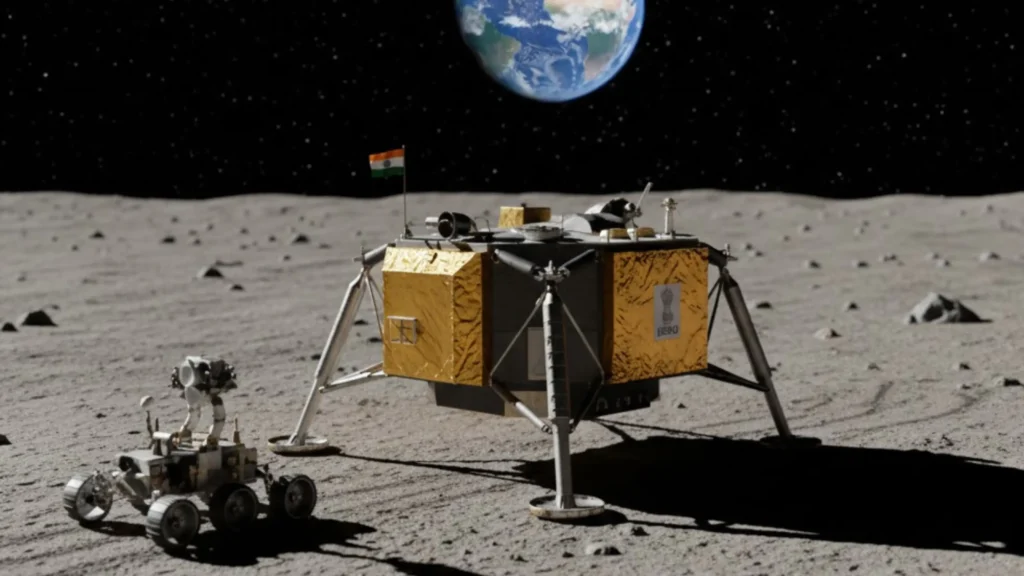
Humanity’s fascination with the Moon has spanned centuries, from ancient myths to the modern era of space exploration. In this exciting journey, India has emerged as a prominent player with its Chandrayaan series of missions. Among these, Chandrayaan-3 shines as a beacon of scientific and technological advancement, promising to extend our understanding of the Moon and beyond. In the realm of space exploration, India continues to make remarkable strides with its ambitious space missions. Among these endeavors, the Chandrayaan series stands out as a testament to India’s scientific prowess and its dedication to unraveling the mysteries of the cosmos. The Chandrayaan-3 is the country’s ongoing lunar mission that promises to further expand our understanding of the Moon and space exploration as a whole. Unveiling the Chandrayaan Saga The Chandrayaan series is a testament to India’s space agency, the Indian Space Research Organisation (ISRO), and its dedication to unraveling the mysteries of the cosmos. Beginning with Chandrayaan-1 in 2008, the series marked a significant milestone for India, as it discovered evidence of water molecules on the lunar surface. This groundbreaking revelation challenged existing theories about the Moon’s history and potential as a stepping stone for future space exploration. On October 22, 2008, India’s inaugural lunar mission, Chandrayaan-1, achieved a successful launch from SDSC SHAR, Sriharikota. The spacecraft effectively maintained an orbit around the Moon, maintaining a distance of 100 km above the lunar surface. Its primary mission involved conducting chemical, mineralogical, and photo-geologic mapping of the Moon. To achieve this, the spacecraft was equipped with a total of 11 scientific instruments, developed collaboratively by experts from India, the USA, UK, Germany, Sweden, and Bulgaria. Building on the success of Chandrayaan-1, ISRO launched Chandrayaan-2 in 2019. The Chandrayaan-2 mission stands as a notably intricate endeavor, signifying a substantial technological advancement in comparison to previous ISRO missions. It encompassed three integral components: an Orbiter, a Lander, and a Rover, all aimed at investigating the uncharted South Pole of the Moon. This mission’s core objective involves enriching lunar scientific understanding by conducting comprehensive examinations of various aspects, including topography, seismography, mineral distribution and identification, surface chemical composition, thermal characteristics of the uppermost soil layer, and the composition of the delicate lunar atmosphere. What sets this mission apart is its comprehensive scope, aiming to study not only specific lunar regions but also encompassing the exosphere, surface, and sub-surface areas in a unified mission. Currently, ISRO has launched Chandrayaan-3 on July 14, 2023, at 14:35 Hrs. IST from the Second Launch Pad, SDSC-SHAR, Sriharikota. As on August 20th 2023, the Lander Module is currently positioned in a orbit of 25 km x 134 km. The anticipated commencement of the powered descent is scheduled for August 23, 2023, at approximately 1745 Hrs. IST. Detailed Overview of Chandrayaan-3 Chandrayaan-3 serves as a subsequent mission to Chandrayaan-2, aiming to showcase a comprehensive capacity for secure lunar surface landing and subsequent rover movement. This mission comprises both Lander and Rover components and launched using LVM3 from SDSC SHAR, Sriharikota. The propulsion module’s role encompasses transporting the Lander and Rover configuration until they reach a lunar orbit of 100 km. Notably, the propulsion module is equipped with the Spectro-polarimetry of Habitable Planet Earth (SHAPE) payload, designed to conduct spectral and polarimetric measurements of Earth while situated in lunar orbit. Lander Payloads: The Lander is equipped with various scientific instruments, including Chandra’s Surface Thermophysical Experiment (ChaSTE), which serves to measure both the thermal conductivity and temperature. Another important addition is the Instrument for Lunar Seismic Activity (ILSA), responsible for assessing seismic activity in the vicinity of the landing site. Additionally, the Langmuir Probe (LP) is integrated into the Lander’s payload suite to effectively estimate plasma density and its fluctuations. An interesting inclusion is the passive Laser Retroreflector Array provided by NASA, strategically incorporated to facilitate lunar laser ranging studies. Rover Payloads: The Rover, on the other hand, carries distinctive scientific tools, such as the Alpha Particle X-ray Spectrometer (APXS) and the Laser Induced Breakdown Spectroscope (LIBS). These instruments play a crucial role in analyzing the elemental composition of the terrain surrounding the landing site. Comprising an indigenous Lander module (LM), Propulsion module (PM), and a Rover, Chandrayaan-3 is driven by the objective of developing and showcasing novel technologies essential for interplanetary missions. A pivotal capability of the Lander is its aptitude for executing a gentle landing at a designated lunar location. Subsequently, the Rover will be deployed to conduct on-site chemical analyses of the lunar surface as it navigates its path. Both the Lander and the Rover house scientific payloads tailored for conducting experiments on the lunar terrain. Operating from the launch vehicle injection to the final lunar orbit at a 100 km circular polar distance, the Propulsion Module (PM) plays a vital role in transporting the Lander (LM) and then detaching it upon arrival. Adding to its significance, the Propulsion Module features an additional scientific payload, enhancing its value by facilitating experiments post-separation of the Lander Module. The GSLV-Mk3 has been selected as the designated launcher for Chandrayaan-3. This launch vehicle will position the integrated module into an Elliptic Parking Orbit (EPO), characterized by dimensions approximately 170 km x 36,500 km. Chandrayaan-3’s mission encompasses the following key objectives: Demonstration of Safe and Soft Lunar Landing: This involves showcasing the ability to safely land on the lunar surface with precision. Rover Mobility on the Moon: Chandrayaan-3 aims to demonstrate the maneuvering capabilities of a rover on the lunar terrain. In-Situ Scientific Experiments: The mission seeks to conduct scientific analyses directly on the lunar surface. To fulfill these objectives, Chandrayaan-3 incorporates a range of advanced technologies within its Lander module: Altimeters: Cutting-edge altimeter systems, including Laser and RF-based technologies, are employed for precise altitude measurements. Velocimeters: The mission utilizes Laser Doppler Velocimeter and Lander Horizontal Velocity Camera systems to measure and analyze velocities. Inertial Measurement: Laser Gyro-based Inertial referencing and Accelerometer packages contribute to accurate measurements and references. Propulsion System: An advanced propulsion setup consists of 800N Throttleable Liquid Engines, 58N attitude